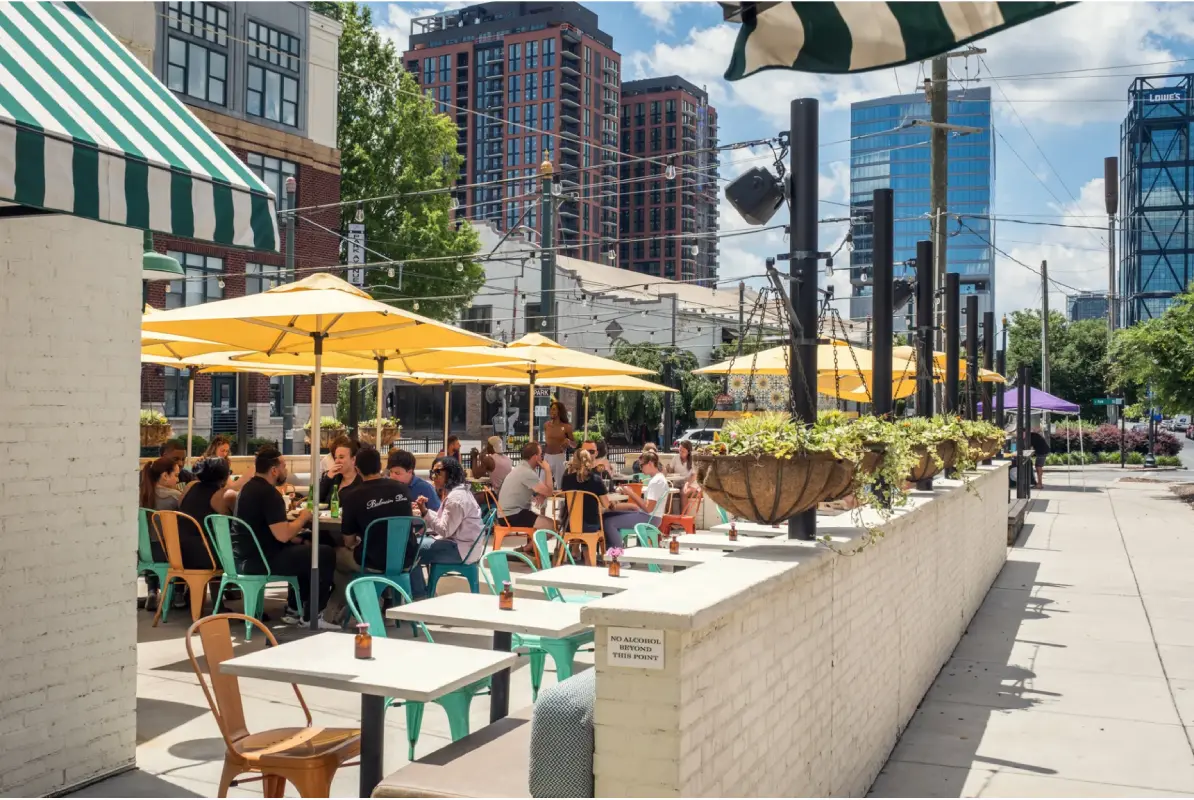
South End's crash risk reflects its transformation from industrial warehouse district into Charlotte's fastest-growing urban neighborhood, where light rail, nightlife foot traffic, cyclists, and dense vehicle traffic now share the same narrow corridor.
South Boulevard, identified in City of Charlotte Vision Zero enforcement materials as a high-priority corridor, runs the length of South End and mixes light rail crossings, vehicle traffic, cyclists, and heavy pedestrian volume in one of the densest stretches in the city.
South End's rapid apartment and retail growth over the past decade has added thousands of new residents and visitors without a proportional increase in road capacity, concentrating traffic at a handful of signalized crossings along South Boulevard and Camden Road.
CMPD handles crash response throughout South End, and the neighborhood's stretch of South Boulevard is specifically named in Charlotte's Vision Zero enforcement-area materials as a corridor where vehicle traffic, transit, pedestrians, cyclists, and business access overlap.
Atrium Health Carolinas Medical Center, the region's adult Level I trauma center, is only minutes from South End, giving crash victims fast access to the highest level of trauma care in the Charlotte metro.
.webp)
Car accidents are a serious issue in South End because one of Charlotte's most explosive growth areas funnels light rail trains, cyclists, nightlife pedestrian traffic, and heavy vehicle volume onto a single dominant corridor — South Boulevard — that was not built for its current density.
South End has grown faster than almost any other neighborhood in Charlotte, converting former mill and warehouse buildings into apartments, breweries, restaurants, and offices at a pace the surrounding road network has struggled to match. South Boulevard, the neighborhood's spine, now carries the Lynx Blue Line light rail, heavy vehicle traffic, delivery and rideshare activity, and large volumes of pedestrians and cyclists moving between bars, restaurants, and transit stops.
The City of Charlotte's Vision Zero enforcement-area materials specifically name the South Boulevard corridor — from the Rensselaer Avenue area to Scott Avenue and beyond — as a location where vehicle traffic, transit, pedestrians, cyclists, and business access all overlap. That overlap is exactly what makes South End crashes different from a typical two-vehicle collision: many involve a pedestrian, cyclist, or rideshare passenger crossing at an unmarked or mid-block location amid nightlife foot traffic.
Weekend evenings are a particular flashpoint. Bar and restaurant traffic along South Boulevard and Camden Road brings a mix of pedestrians — some walking between venues, some crossing light rail tracks — into direct contact with vehicle and rideshare traffic circling for parking or drop-offs, a combination that produces both vehicle collisions and pedestrian-involved crashes.
Which roads and traffic conditions create the most risk in South End?
The roads that create the most risk in South End include South Boulevard, Camden Road, Tremont Avenue, West Boulevard, Bland Street, and the I-277 loop bordering the neighborhood's northern edge.
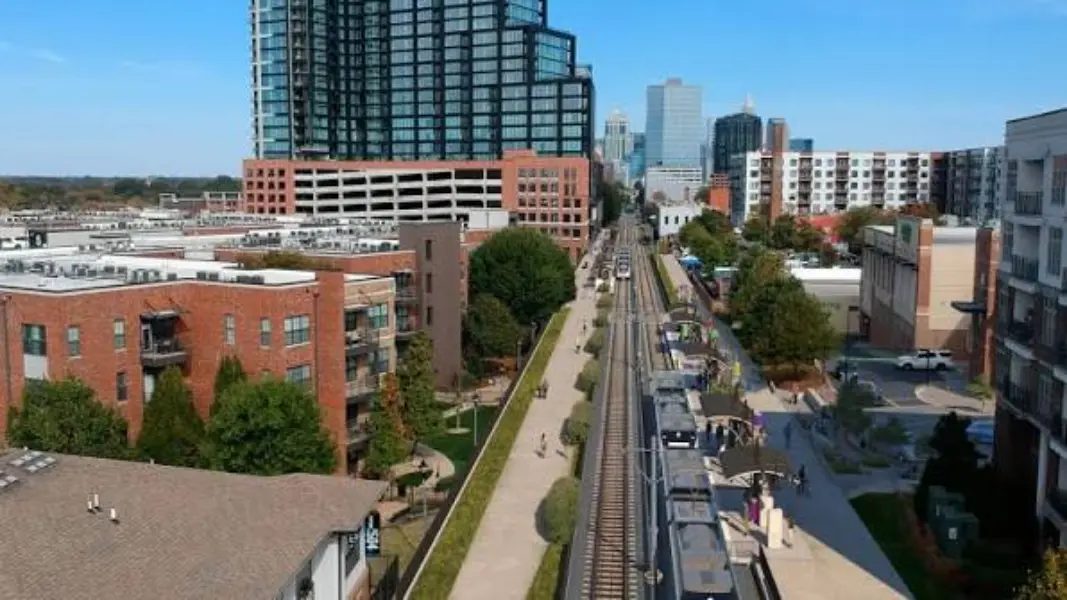
South Boulevard dominates South End's crash risk profile. It carries the light rail line down its center, vehicle traffic on either side, and constant pedestrian crossings near each light rail stop. Rear-end collisions are common where vehicles slow suddenly for trains or pedestrians, and the corridor's business access points create frequent turning conflicts.
Camden Road runs parallel to South Boulevard through the densest restaurant and brewery district and carries heavy weekend pedestrian and rideshare traffic. Tremont Avenue connects South End to Wilmore and carries commuter cut-through traffic that intersects with South Boulevard's light rail crossings at several points.
Bland Street and West Boulevard mark South End's southern transition zone, where increasing residential density has added local traffic to what were previously lower-volume industrial streets. The I-277 loop along South End's northern edge adds another risk factor, as highway traffic transitions to neighborhood-street speeds at several ramp locations feeding directly into South Boulevard.
Major roads and corridors in South End
South Boulevard — South End's central spine carrying light rail, heavy vehicle traffic, and constant pedestrian crossings near transit stops; the corridor is specifically named in Charlotte's Vision Zero enforcement materials.
Camden Road — Parallel corridor through the densest restaurant and brewery district; heavy weekend pedestrian and rideshare activity.
Tremont Avenue — Connector to Wilmore carrying commuter cut-through traffic that crosses the light rail line at multiple points.
West Boulevard — Southern transition corridor with growing residential traffic mixing with through-commuters.
Bland Street — Local connector near the Design Center area with business access points and turning conflicts.
I-277 / Brookshire-Belk Freeway loop — Highway boundary on South End's north side; ramp traffic transitioning to South Boulevard speeds creates merging risk.
Dangerous intersections and congestion zones in South End
South Boulevard at Bland Street — Heavy pedestrian, transit, and business-access traffic near the Design Center and light rail stop.
South Boulevard at Tremont Avenue — Light rail stop with significant pedestrian crossing volume mixed with commuter and nightlife vehicle traffic.
Camden Road at Winnifred Street — Dense restaurant and brewery corridor with weekend pedestrian and rideshare congestion.
South Boulevard at West Boulevard — Southern gateway intersection where through-traffic and local residential traffic converge.
South Boulevard at the I-277 ramps — Transition zone where highway-speed traffic merges into South End's dense, slower-speed corridor.
What should you do after a car accident in South End?
After a South End car accident: call 911, get medical care, document the scene, request the crash report from Charlotte-Mecklenburg Police Department (CMPD) or Mecklenburg County Sheriff's Office, and avoid giving detailed insurance statements before you understand how North Carolina's contributory negligence rule affects your claim.
1. Call 911. Charlotte-Mecklenburg Police Department (CMPD) handles crash response inside city limits. Mecklenburg County Sheriff's Office responds in unincorporated Mecklenburg areas. North Carolina Highway Patrol (NCHP) responds on state highways and interstates.
2. Seek medical care. Atrium Health Carolinas Medical Center on Blythe Boulevard, a short distance from South End's northern edge is the primary acute-care facility for the area. For serious trauma requiring a Level I resource, Atrium Health Carolinas Medical Center (Level I trauma center) and Levine Children's Hospital (Level I pediatric trauma center) serves as the regional trauma center.
3. Document the scene. Photograph vehicle damage, road conditions, traffic signals, skid marks, and injuries. Business cameras and NCDOT cameras along South Boulevard and I-277 (Brookshire/Belk Freeway) may have recorded the crash.
4. Collect witness and insurance information. Get names and phone numbers. Do not discuss fault at the scene.
5. Request the crash report. Charlotte-Mecklenburg Police Department (CMPD) crash reports can be requested through the department's records division. For state highway crashes investigated by North Carolina Highway Patrol (NCHP), NCDOT's online crash report portal provides access.
6. Be careful with insurance calls. North Carolina's contributory negligence rule means early fault statements can damage your claim.
7. Speak with a lawyer before settling. Your settlement should account for all medical costs, lost income, and the long-term impact of your injuries.
Talk to a South End car accident lawyer today
If you were injured in a South End car accident, we can help you understand how North Carolina law applies to your claim, what your case may be worth, and how to protect your rights through the insurance process.
Frequently asked questions
What should I do immediately after a car accident in South End?
Call 911, get medical care, photograph the scene, collect witness information, and request the crash report from Charlotte-Mecklenburg Police Department (CMPD) or North Carolina Highway Patrol (NCHP). Be careful with early statements to insurance companies — your words about fault matter under North Carolina law.
Which roads in South End have the highest crash risk?
The roads that create the most risk in South End include South Boulevard, Camden Road, Tremont Avenue, West Boulevard, Bland Street, and the I-277 loop bordering the neighborhood's northern edge.
How do I get a crash report after a South End accident?
Charlotte-Mecklenburg Police Department (CMPD) crash reports can be requested through the department's records division. For crashes on state highways investigated by North Carolina Highway Patrol (NCHP), reports are available through NCDOT's online crash report portal or through North Carolina Highway Patrol (NCHP) records. Allow a few days after the crash before requesting.
Where should I go for emergency medical care after a serious South End crash?
Atrium Health Carolinas Medical Center on Blythe Boulevard, a short distance from South End's northern edge provides emergency and acute care for crash victims in the South End area. For the most serious trauma requiring Level I or II resources, Atrium Health Carolinas Medical Center (Level I trauma center) and Levine Children's Hospital (Level I pediatric trauma center) is accessible for critical cases.
How does North Carolina's contributory negligence rule affect my South End car accident claim?
North Carolina follows contributory negligence, meaning an injured person may be barred from any recovery if found even slightly at fault for the crash. This rule — followed in only a handful of states — makes how fault is handled from the very beginning of a South End car accident case critically important. Insurance companies are aware of this rule and may use early statements to argue the injured person contributed to the crash.