
Charlotte DUI Crash Kills 8-Year-Old Passenger: What North Carolina Families Need to Know About Wrongful Death Claims
A speeding, allegedly impaired driver crashed into a tree near Independence Boulevard in Charlotte, killing an 8-year-old passenger. Here's what North Carolina law says about wrongful death claims, punitive damages in DUI cases, and the state's tough contributory negligence rule.
A speeding, allegedly impaired driver leaves a Charlotte family grieving the loss of an 8-year-old child — and raises questions every North Carolina parent should understand about wrongful death and punitive damages.
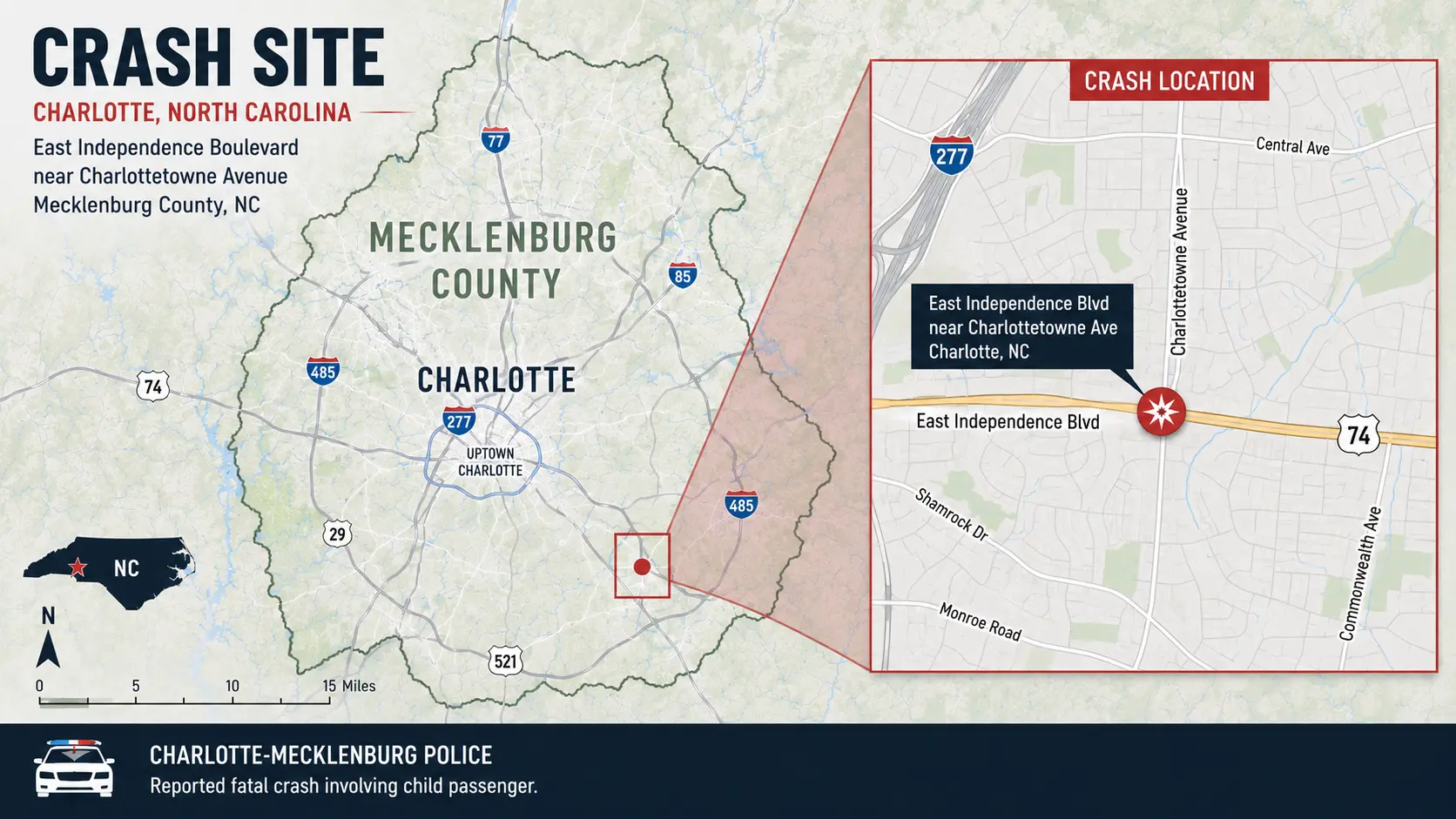
In the early morning hours near East Independence Boulevard and Charlottetowne Avenue in Charlotte, a vehicle traveling westbound at a high rate of speed left the roadway and struck a tree. According to WBTV and Queen City News, Charlotte-Mecklenburg police found an 8-year-old passenger unresponsive inside the vehicle. The child was pronounced dead at the scene.
The 32-year-old driver was found near the rear of the vehicle with non-life-threatening injuries. Police allege she was traveling nearly 80 mph in a 50 mph zone and was impaired at the time of the crash. She has since been charged with felony death by vehicle, reckless driving, and speeding, and was placed under a $1 million bond.
Independence Boulevard is one of Charlotte's busiest corridors, feeding directly into the I-277 loop around Uptown. High speed differentials, late-night traffic, and impaired driving make stretches like this especially dangerous — and this crash was no accident of fate. It was the foreseeable result of a driver allegedly choosing to get behind the wheel while impaired.
While the criminal case moves through Mecklenburg County courts, the child's family is left facing a separate, and often unfamiliar, legal process: a civil wrongful death claim. Here is what North Carolina law says about that process, and why a felony DUI charge can matter so much to a family's case.
Wrongful Death Claims in North Carolina: Who Can Sue and What Can Be Recovered
Under North Carolina's wrongful death statute (N.C. Gen. Stat. § 28A-18-2), a claim must be brought by the personal representative of the deceased's estate — typically a parent or court-appointed administrator in the case of a child. The claim is filed on behalf of the surviving family members who depended on or were close to the person who died.
Recoverable damages in a North Carolina wrongful death case can include:
- Medical expenses incurred before death
- Funeral and burial expenses
- Loss of the companionship, guidance, and society the deceased would have provided to surviving family
- The pain and suffering experienced by the deceased between injury and death, where applicable
- Punitive damages, where the at-fault party's conduct was willful, wanton, or grossly negligent
These cases are among the most serious a family will ever face, and North Carolina law recognizes that the loss extends well beyond medical bills — it recognizes the loss of a relationship that can never be replaced.
Why a Felony DUI Charge Can Increase the Value of a Civil Claim
North Carolina permits punitive damages in cases involving fraud, malice, or willful and wanton conduct — a standard that driving while impaired to the point of causing a death has repeatedly been found to satisfy. Punitive damages are not meant to compensate the family for their loss; they exist to punish especially reckless conduct and to send a message that this kind of behavior will not be tolerated.
Importantly, North Carolina generally caps punitive damages at the greater of three times compensatory damages or $250,000 — but state law carves out an exception for defendants convicted of impaired driving that causes the injury or death at issue. That distinction can make a significant difference in how a DUI wrongful death case is valued compared to an ordinary negligence claim, and insurance carriers handling these cases are well aware of it.
North Carolina's Contributory Negligence Rule — and Why It Rarely Affects an Innocent Passenger
North Carolina follows one of the strictest fault rules in the country: pure contributory negligence. Under this rule, if an injured person is found even 1% at fault for the crash that harmed them, they can be completely barred from recovering anything — a far harsher standard than the comparative negligence rules used in most other states, including South Carolina.
This rule is a critical reason why insurance companies fight so hard over small details in North Carolina crash cases. But it's important for families to understand its limits: a child passenger who has no control over how a vehicle is driven cannot be found contributorily negligent for a driver's decision to speed or drive impaired. Passengers, particularly children, are almost always the most protected class of claimant in a North Carolina crash case.
The Civil Case Does Not Have to Wait for the Criminal Case
Families often assume a wrongful death claim must wait until the criminal charges are resolved. It does not. North Carolina's civil and criminal systems operate independently, and a wrongful death claim can be filed and actively investigated while criminal proceedings are still pending. Evidence such as the collision report, toxicology results, and witness statements can become harder to obtain the longer a family waits, which is why early action matters.
If you have lost a child or other loved one in a crash caused by an impaired or reckless driver in North Carolina, you do not have to face the legal process alone. At Biazzo Injury Law, we represent grieving families across the Carolinas in wrongful death and serious injury cases. We offer free consultations, and you pay no fee unless we recover for you. Contact us today to discuss your family's rights.
The facts referenced in this article reflect publicly reported information from WBTV and Queen City News. This post is intended for general educational purposes and does not constitute legal advice. Every case is different; contact an attorney to discuss your specific circumstances.


