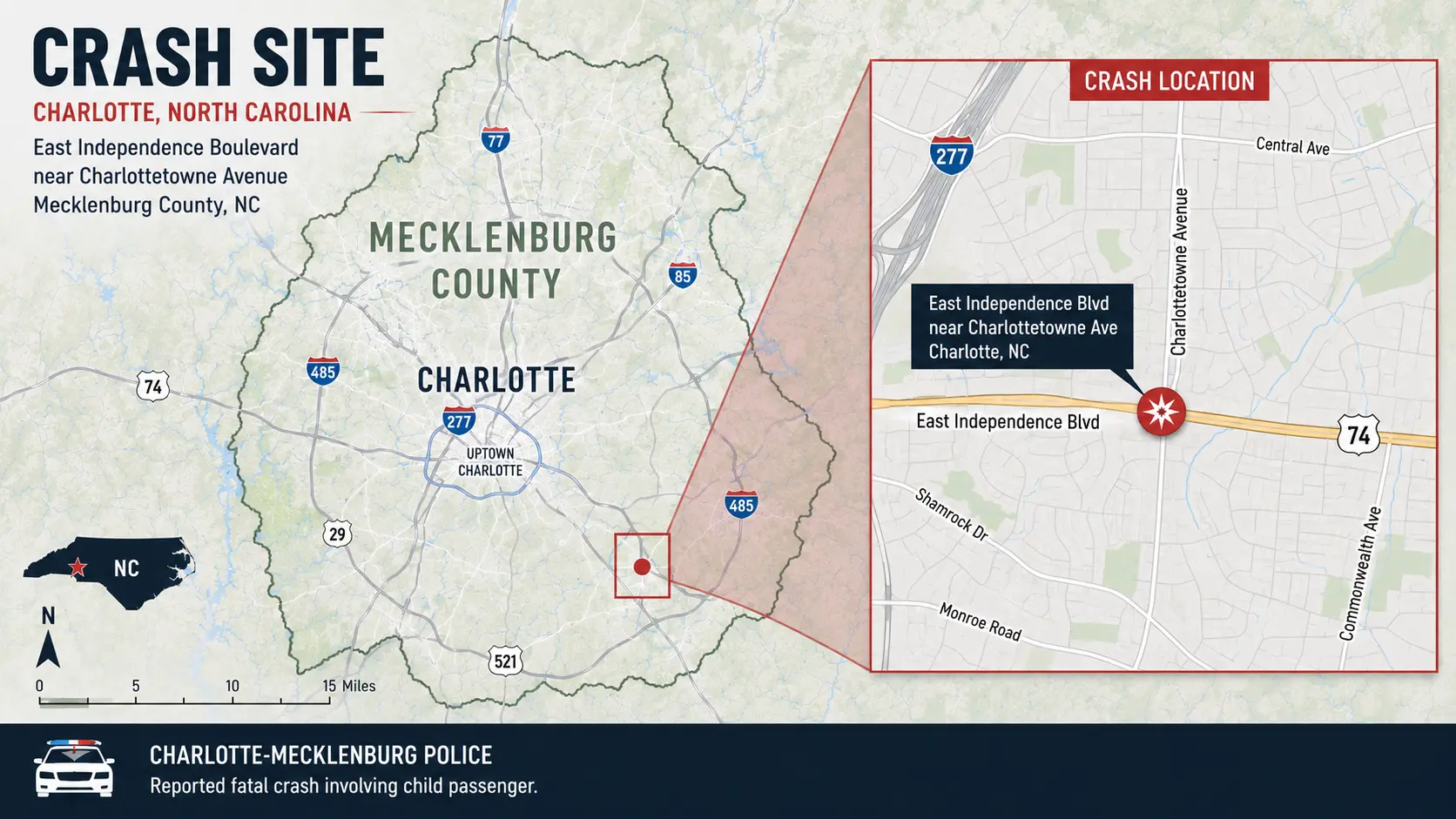

Charlotte's crash risk is shaped by rapid growth, major interstate corridors, and a documented High Injury Network where just 13% of streets account for roughly 80% of fatal and serious-injury crashes.
Charlotte's highest risk roads and interections represents only 13% of the city's street network but accounts for approximately 80% of fatal and serious-injury crashes, according to City of Charlotte Vision Zero
Charlotte's Vision Zero program identifies speeding, impaired driving, and distracted driving as the leading behavioral factors in traumatic crashes across the city's High Injury Network corridors.
CMPD uses serious-injury and fatal crash data to target enforcement in Charlotte's Vision Zero enforcement-area corridors, focusing on speeding, impaired driving, seatbelt violations, and distracted driving.
Atrium Health operates Charlotte's adult Level I trauma center at Carolinas Medical Center and the pediatric Level I trauma center at Levine Children's Hospital and is the region's highest-level trauma centers

Car accidents are a serious issue in Charlotte because the city combines rapid growth, major interstate corridors, and a documented concentration of fatal and serious crashes on a small share of its street network. Charlotte's High Injury Network shows that crash risk is not evenly distributed — it clusters on specific corridors where speed, traffic volume, and vulnerable road user activity overlap.
Charlotte is the largest city in North Carolina and one of the Southeast's busiest transportation hubs. Drivers navigate I-77, I-85, I-485, I-277, and US-74 / Independence Boulevard daily alongside local arterials connecting Uptown, University City, south Charlotte, west Charlotte, and the airport corridor. That mix creates many points where crashes occur
The City of Charlotte's Vision Zero program shows that serious crashes are not random. The high injury areas listed below represents only 13% of Charlotte's street network but accounts for roughly 80% of fatal and serious-injury crashes. That concentration means where a crash happened — and the traffic conditions at that location — matters significantly when evaluating a claim.\n\nInsurance companies often narrow their focus to driver behavior. A thorough claim may also require examining road environment, crash location within a known high-risk corridor, available camera or witness evidence, and prior crash patterns at the same location.
Which roads and traffic conditions create the most risk in Charlotte?
The roads that create the most risk in Charlotte include I-77, I-85, I-485, I-277, US-74 / Independence Boulevard, North Tryon Street, West Sugar Creek Road, Albemarle Road, South Boulevard, and WT Harris Boulevard. Charlotte's Vision Zero enforcement-area materials identify specific corridors where traffic safety efforts are concentrated based on serious crash data.

Charlotte's road risk comes from how the city is built: interstates carry high-speed traffic across the metro while major arterial roads carry commuters through dense commercial and residential areas. The most serious crashes often happen where these systems meet such as interstate ramps, signalized intersections, multilane arterials with turning movements, and corridors where pedestrians, cyclists, and buses share space with vehicle traffic.
Charlotte's Vision Zero enforcement-area materials identify specific corridors for targeted safety enforcement based on serious crash concerns. These include: Albemarle Road, Archdale Drive, Beatties Ford Road, Central Avenue, Eastway Drive, Freedom Drive, Monroe Road, Mount Holly Road, North Tryon Street, Pineville-Matthews Road, Providence Road, South Boulevard, West Boulevard, Wilkinson Boulevard, West Sugar Creek Road, and portions of WT Harris Boulevard.
Atrium Health's trauma centers serve crash victims across the region, and motor vehicle collisions are identified as a leading trigger for trauma team activation a reminder that Charlotte crashes can quickly become serious medical and legal events.
Major roads and corridors in Charlotte
I-77 — Major north-south commuter and freight corridor through Charlotte. Crashes often involve speed, merging traffic, congestion, and sudden slowdowns near Uptown.
I-85 — Regional highway carrying commercial traffic, commuters, and long-distance drivers. Significant for truck-involved crashes and high-speed impacts.
I-485 — Charlotte's outer loop with heavy merging and lane-change activity near suburban growth areas.
I-277 / Uptown Loop — Short merge distances and dense traffic near Uptown create complex crash scenarios.
US-74 / Independence Boulevard — High-volume east-west corridor with signalized intersections and commuter congestion toward southeast Charlotte and Matthews.
North Tryon Street — Key north Charlotte corridor with commuter, commercial, pedestrian, and transit activity.
West Sugar Creek Road — Area between North Tryon Street and I-85 that often see heavy traffic and numerious crashes.
Albemarle Road — East Charlotte corridor in enforcement-area materials with congestion, turning traffic, and commercial access points.
South Boulevard — South Charlotte corridor where vehicle traffic, transit, pedestrians, cyclists, and business access overlap.
Wilkinson Boulevard / West Boulevard / Freedom Drive — West Charlotte corridors serving airport-area, commuter, and commercial traffic.
Dangerous intersections and congestion zones in Charlotte
Charlotte's most serious crash risk is corridor-based. The High Injury Network shows that a small portion of streets accounts for a very large share of fatal and serious crashes, meaning road segments and intersection clusters matter more than isolated intersections.
West Sugar Creek Road between North Tryon Street and I-85 is a locally significant enforcement corridor combining commercial traffic, commuter movement, and major route access.\n\nNorth Tryon Street from West Sugar Creek Road to University City Boulevard includes high traffic volume, transit activity, and dense development.
Albemarle Road from Reddman Road to Lake Point Road is listed as one of Charlotte's worst intersections for serious injurioes and reflects east Charlotte risk patterns: stop-and-go traffic, turning vehicles, pedestrians, and commercial entrances.
South Boulevard near Rensselaer Avenue to Script Lane is an enforcement corridor reflecting dense urban development, transit proximity, and heavy vehicle movement.
Other corridors requiring attention include Monroe Road, WT Harris Boulevard, Beatties Ford Road, Central Avenue, Eastway Drive, Freedom Drive, Pineville-Matthews Road, Providence Road, West Boulevard, and Wilkinson Boulevard.
Local Resources for Accident Victims in Charlotte
What should you do after a car accident in Charlotte?
After a Charlotte car accident: call 911, get medical care, document the scene, request the crash report, and avoid giving detailed insurance statements before you understand your rights. North Carolina's contributory negligence rule makes early statements particularly risky.
1. Call 911. CMPD responds within Charlotte city limits. On highways or outside city limits, NCHP or another agency may handle the investigation.
2. Seek medical care. For serious trauma, Atrium Health Carolinas Medical Center (adult Level I) and Levine Children's Hospital (pediatric Level I) are Charlotte's highest-level trauma resources. Novant Health Presbyterian Medical Center is another major Charlotte system resource.
3. Document the scene. Photograph vehicle damage, road conditions, traffic signals, skid marks, debris, and injuries. Business cameras, traffic cameras, and dash cameras in Charlotte can become critical evidence.
4. Collect witness and insurance information. Get names and phone numbers from any witnesses. Do not discuss fault at the scene.
5. Request the crash report. CMPD states crash reports are free at division offices or Police Headquarters (601 E. Trade Street) and avaliabe through the LexisNexis Accident Reporting.
6. Be careful with insurance calls. North Carolina's contributory negligence rule means insurers may use early statements to argue you contributed to the crash, potentially barring your recovery.
7. Speak with a lawyer before settling. Your settlement should account for medical bills, future treatment, lost wages, pain and suffering, and long-term limitations.
Talk to a Charlotte Car Accident Lawyer Today
If you were injured in a Charlotte car accident, you do not have to handle the insurance process alone. We can help you understand your options, protect your claim, and build a strategy around the facts of your crash and North Carolina law.
Frequently asked questions
What should I do immediately after a car accident in Charlotte?
Call 911, get medical care, document the scene with photos, collect witness information, and request the crash report. Avoid giving detailed fault statements to insurance companies until you understand how North Carolina's contributory negligence law may affect your claim.
Which roads in Charlotte have the highest crash risk?
Major risk corridors include I-77, I-85, I-485, I-277, Independence Boulevard, North Tryon Street, West Sugar Creek Road, Albemarle Road, South Boulevard, WT Harris Boulevard, and other streets identified in Charlotte's Vision Zero enforcement-area materials. The High Injury Network identifies specific corridors where fatal and serious crashes concentrate.
How do I get a crash report after a Charlotte accident?
CMPD crash reports can be obtained at CMPD division offices or Police Headquarters (601 E. Trade Street) at no charge, or through the LexisNexis Accident Reporting system for $9.00. For NCHP-investigated crashes on Charlotte interstates, NCDOT's online crash portal provides access.
Where should I go for emergency medical care after a serious Charlotte crash?
Atrium Health Carolinas Medical Center is Charlotte's adult Level I trauma center and Levine Children's Hospital is the pediatric Level I trauma center, both identified as the region's highest trauma-level resources in Vision Zero materials. Novant Health Presbyterian Medical Center is another major Charlotte system resource.
How does North Carolina's contributory negligence rule affect my Charlotte car accident claim?
North Carolina follows contributory negligence, meaning an injured person may be barred from any recovery if found even slightly at fault for the crash. This rule — followed in only a handful of states — makes how fault is handled from the very beginning of a Charlotte car accident case critically important. Insurance companies are aware of this rule and may use early statements to argue the injured person contributed to the crash.