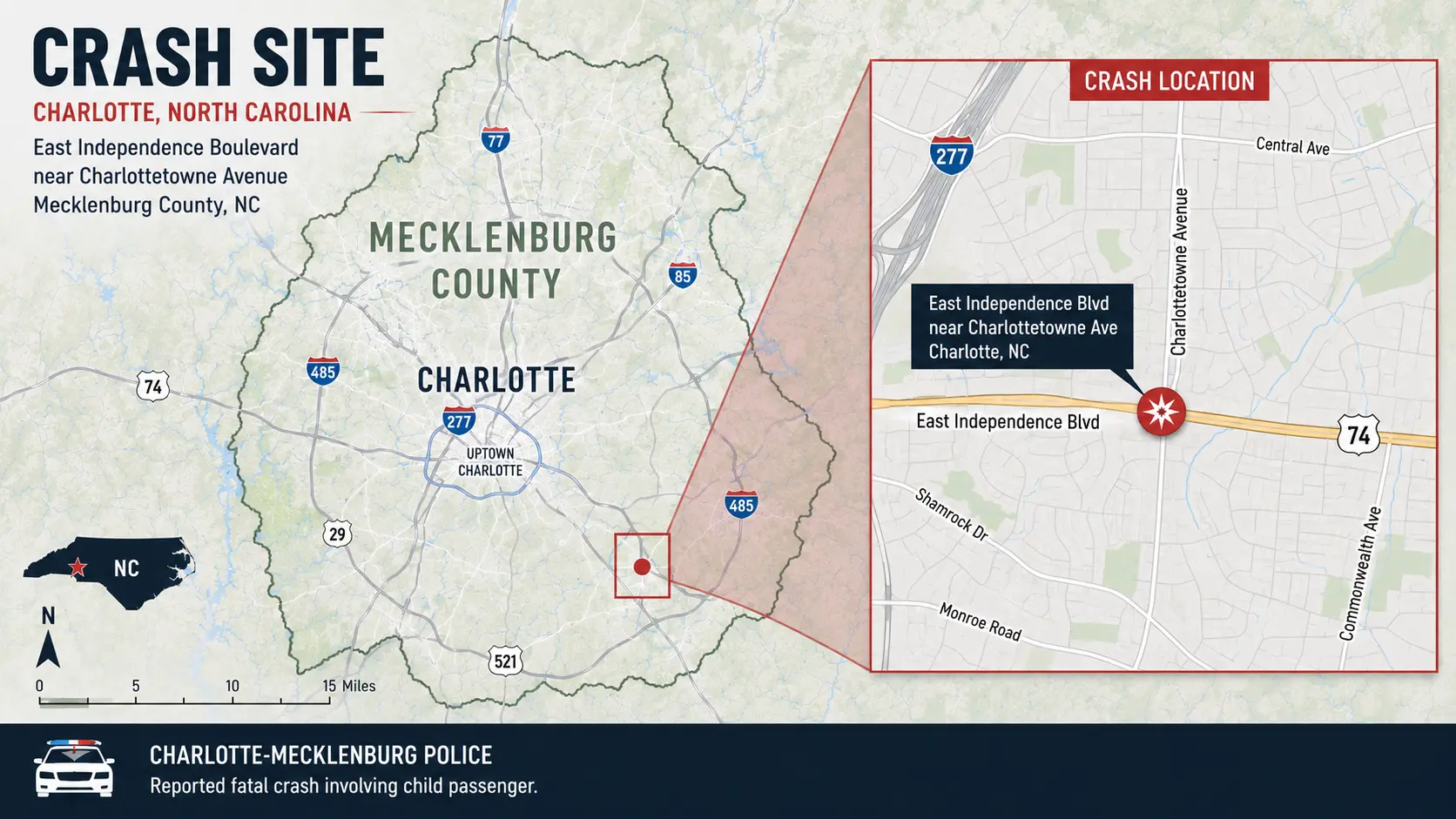

Elizabeth's crash risk is shaped by its position between two major hospital campuses and Independence Boulevard, one of Charlotte's highest-volume commuter corridors bordering the neighborhood's southern edge.
Independence Boulevard (US-74), which forms Elizabeth's southern boundary, is one of the busiest commuter and commercial corridors in the Charlotte region and a corridor the City of Charlotte has repeatedly targeted through Vision Zero-related safety initiatives.
Elizabeth's location between Novant Health Presbyterian Medical Center and Atrium Health Mercy means the neighborhood carries an unusually high volume of hospital-related traffic — ambulances, staff, and visitors — layered onto its historic residential streets.
CMPD handles crash response throughout Elizabeth, and NCDOT crash data identifies the Independence Boulevard corridor along the neighborhood's edge as a persistent higher-risk zone for both vehicle and pedestrian crashes.
Elizabeth is one of the few Charlotte neighborhoods bordered by two major hospital campuses — Novant Health Presbyterian Medical Center and Atrium Health Mercy — giving crash victims exceptionally fast access to emergency care.
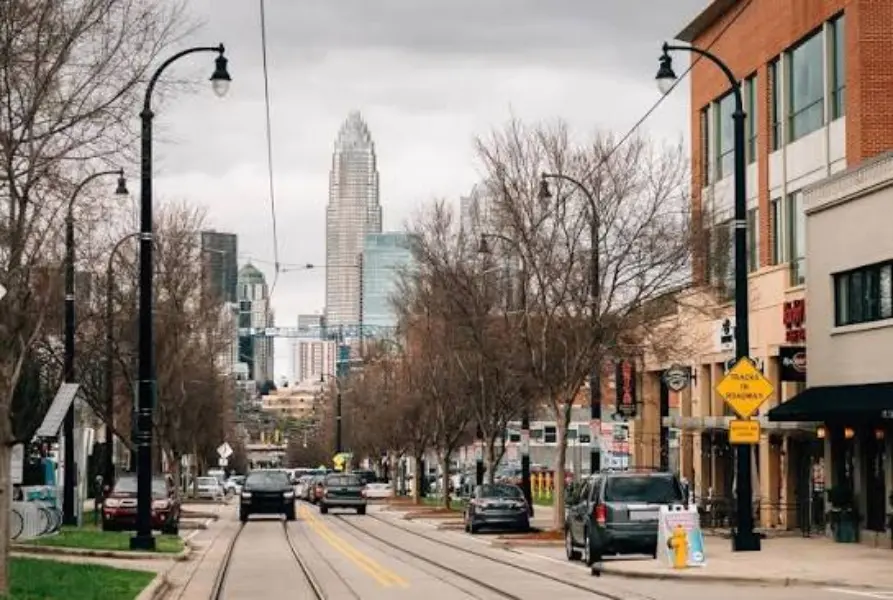
Car accidents are a serious issue in Elizabeth because the neighborhood sits directly against Independence Boulevard, one of Charlotte's busiest commuter corridors, while also absorbing heavy hospital-related traffic from two major medical campuses on its borders.
Elizabeth is one of Charlotte's oldest and most walkable neighborhoods, home to Independence Park, historic bungalows, and a small commercial village center along Elizabeth Avenue and 7th Street. Its crash risk, however, is driven largely by geography: Elizabeth sits directly against Independence Boulevard (US-74), one of the highest-volume commuter and commercial corridors in the entire Charlotte region, and is bordered by two major hospital campuses.
Independence Boulevard carries substantial regional traffic connecting Uptown to Matthews, Monroe, and points east, and the ramp and access-road system where it meets Elizabeth's residential streets creates a documented pattern of higher-speed crashes transitioning into a much slower neighborhood environment. NCDOT crash data consistently flags this transition zone as a higher-risk area.
At the same time, Elizabeth's position next to Novant Health Presbyterian Medical Center on Hawthorne Lane and Atrium Health Mercy on Vail Avenue means the neighborhood absorbs significant hospital-related traffic — ambulances responding to emergencies, staff shift changes, and visitor traffic — on top of normal commuter and local activity, adding another layer of vehicle movement to Elizabeth's compact street grid.
Which roads and traffic conditions create the most risk in Elizabeth?
The roads that create the most risk in Elizabeth include Independence Boulevard, Hawthorne Lane, Elizabeth Avenue, Kings Drive, 7th Street, and Louise Avenue.

Independence Boulevard along Elizabeth's southern edge is the neighborhood's dominant risk corridor. High-speed regional commuter traffic transitioning to local access roads and Elizabeth's residential streets creates conditions for serious crashes, particularly at ramp and access-road intersections.
Hawthorne Lane, bordering Elizabeth to the west, carries heavy hospital-related traffic to and from Novant Health Presbyterian Medical Center alongside regular commuter volume, creating a distinct crash pattern tied to ambulance and visitor traffic in addition to standard vehicle collisions.
Elizabeth Avenue and 7th Street form the neighborhood's commercial core, carrying local restaurant and retail traffic at lower speeds but with meaningful pedestrian activity. Kings Drive and Louise Avenue serve as secondary connectors carrying commuter cut-through traffic between Elizabeth, Plaza Midwood, and Uptown.
Major roads and corridors in Elizabeth
Independence Boulevard (US-74) — Elizabeth's southern boundary and one of Charlotte's highest-volume commuter corridors; ramp and access-road transitions create elevated crash risk.
Hawthorne Lane — Western boundary carrying heavy hospital-related traffic to and from Novant Health Presbyterian Medical Center.
Elizabeth Avenue — Neighborhood commercial core with local restaurant and retail traffic and meaningful pedestrian activity.
Kings Drive — Secondary connector carrying commuter cut-through traffic toward Uptown.7th Street — Local commercial corridor with lower speeds but consistent pedestrian crossings.
Louise Avenue — Residential connector linking Elizabeth to Plaza Midwood with cut-through commuter use.
Dangerous intersections and congestion zones in Elizabeth
Independence Boulevard at Hawthorne Lane — High-speed ramp and access-road transition zone with a documented pattern of serious crashes.
Hawthorne Lane at Elizabeth Avenue — Hospital-adjacent intersection with heavy ambulance, staff, and visitor traffic.
Elizabeth Avenue at Kings Drive — Neighborhood commercial core intersection with pedestrian and local traffic mixing.7th Street at Louise Avenue — Residential cut-through conflict point near Independence Park.
Independence Boulevard at Briar Creek Road — Regional commuter merge zone along Elizabeth's eastern edge.
What should you do after a car accident in Elizabeth?
After a Elizabeth car accident: call 911, get medical care, document the scene, request the crash report from Charlotte-Mecklenburg Police Department (CMPD) or Mecklenburg County Sheriff's Office, and avoid giving detailed insurance statements before you understand how North Carolina's contributory negligence rule affects your claim.
1. Call 911. Charlotte-Mecklenburg Police Department (CMPD) handles crash response inside city limits. Mecklenburg County Sheriff's Office responds in unincorporated Mecklenburg areas. North Carolina Highway Patrol (NCHP) responds on state highways and interstates.
2. Seek medical care. Novant Health Presbyterian Medical Center on Hawthorne Lane, bordering Elizabeth, and Atrium Health Mercy on Vail Avenue within the neighborhood is the primary acute-care facility for the area. For serious trauma requiring a Level I resource, Atrium Health Carolinas Medical Center (Level I trauma center) and Levine Children's Hospital (Level I pediatric trauma center) serves as the regional trauma center.
3. Document the scene. Photograph vehicle damage, road conditions, traffic signals, skid marks, and injuries. Business cameras and NCDOT cameras along Independence Boulevard (US-74) and Hawthorne Lane may have recorded the crash.
4. Collect witness and insurance information. Get names and phone numbers. Do not discuss fault at the scene.
5. Request the crash report. Charlotte-Mecklenburg Police Department (CMPD) crash reports can be requested through the department's records division. For state highway crashes investigated by North Carolina Highway Patrol (NCHP), NCDOT's online crash report portal provides access.
6. Be careful with insurance calls. North Carolina's contributory negligence rule means early fault statements can damage your claim.
7. Speak with a lawyer before settling. Your settlement should account for all medical costs, lost income, and the long-term impact of your injuries.
Talk to a Elizabeth car accident lawyer today
If you were injured in a Elizabeth car accident, we can help you understand how North Carolina law applies to your claim, what your case may be worth, and how to protect your rights through the insurance process.
Frequently asked questions
What should I do immediately after a car accident in Elizabeth?
Call 911, get medical care, photograph the scene, collect witness information, and request the crash report from Charlotte-Mecklenburg Police Department (CMPD) or North Carolina Highway Patrol (NCHP). Be careful with early statements to insurance companies — your words about fault matter under North Carolina law.
Which roads in Elizabeth have the highest crash risk?
The roads that create the most risk in Elizabeth include Independence Boulevard, Hawthorne Lane, Elizabeth Avenue, Kings Drive, 7th Street, and Louise Avenue.
How do I get a crash report after a Elizabeth accident?
Charlotte-Mecklenburg Police Department (CMPD) crash reports can be requested through the department's records division. For crashes on state highways investigated by North Carolina Highway Patrol (NCHP), reports are available through NCDOT's online crash report portal or through North Carolina Highway Patrol (NCHP) records. Allow a few days after the crash before requesting.
Where should I go for emergency medical care after a serious Elizabeth crash?
Novant Health Presbyterian Medical Center on Hawthorne Lane, bordering Elizabeth, and Atrium Health Mercy on Vail Avenue within the neighborhood provides emergency and acute care for crash victims in the Elizabeth area. For the most serious trauma requiring Level I or II resources, Atrium Health Carolinas Medical Center (Level I trauma center) and Levine Children's Hospital (Level I pediatric trauma center) is accessible for critical cases.
How does North Carolina's contributory negligence rule affect my Elizabeth car accident claim?
North Carolina follows contributory negligence, meaning an injured person may be barred from any recovery if found even slightly at fault for the crash. This rule — followed in only a handful of states — makes how fault is handled from the very beginning of a Elizabeth car accident case critically important. Insurance companies are aware of this rule and may use early statements to argue the injured person contributed to the crash.