
Clemson is home to Clemson University — one of South Carolina's largest universities — where US-76, SC-93, and US-123 carry a uniquely high crash risk from the collision of student drivers, game-day traffic surges, pedestrian-heavy corridors near campus, and heavy commercial vehicles on regional state highways.
Clemson's crash environment is heavily shaped by its university population — over 26,000 students — whose driving patterns, pedestrian activity near campus, and concentrated traffic during athletic events create crash conditions that spike dramatically on football game weekends and at the beginning and end of academic terms.
US-76 through Clemson carries regional through-traffic connecting Anderson County to the east and Oconee County to the west, mixing long-haul travelers and commercial vehicles with student pedestrians and campus-area drivers in a corridor that transitions from rural highway to urban campus environment within a short distance.
The Clemson Police Department handles crash response inside city limits and on campus approaches; Pickens County Sheriff's Office covers surrounding unincorporated areas; and SCHP responds to crashes on US-76, SC-93, US-123, and other state highways through the area.
Oconee Medical Center in Seneca (approximately 12 miles west) is the nearest hospital for Clemson crash victims; AnMed Health Medical Center in Anderson is approximately 15 miles east; and Level I Trauma resources are available at Prisma Health Greenville Memorial Hospital approximately 35 miles northeast.
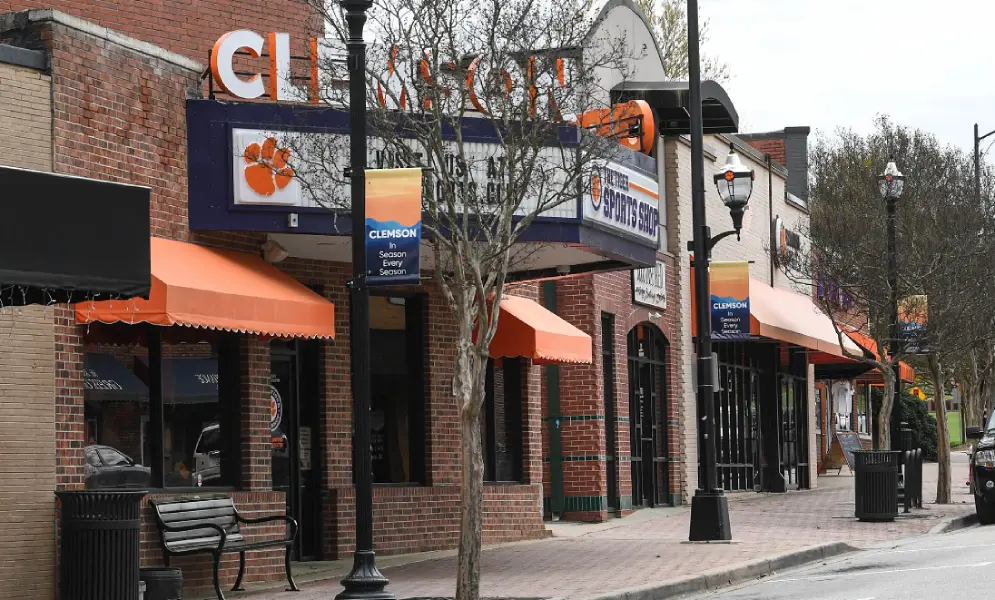
Clemson is a university city with a uniquely complex crash environment — student pedestrian traffic, game-day surges, regional highway through-traffic, and rural-to-urban road transitions all contribute to crash conditions that are unlike any other community in the Upstate.
Clemson is a small city in western Pickens County dominated by Clemson University, which enrolls over 26,000 students and generates a traffic environment unlike any other community of comparable size in South Carolina. The university's presence creates crash risk across several dimensions: high pedestrian activity near campus, student drivers unfamiliar with local roads, concentrated traffic events on football Saturdays and at the start and end of academic semesters, and the mix of regional highway through-traffic with campus-area driving.
US-76 / College Avenue through Clemson is the primary regional highway and the main campus-area commercial corridor. The road carries long-haul travelers moving between Anderson County and Oconee County, local commercial traffic, and students on foot and bicycle — a mix of road users with fundamentally different speed expectations that creates serious crash risk at crosswalks and intersections near campus.
SC-93 south of Clemson connects to Liberty and Easley, carrying commuter and student traffic. The Clemson Police Department covers city streets and campus-adjacent areas, with Pickens County Sheriff's Office covering surrounding unincorporated territory. The nearest hospitals are Oconee Medical Center in Seneca and AnMed Health in Anderson, both approximately 12–15 miles away.
Which roads and traffic conditions create the most risk in Clemson?
US-76 and SC-93 carry the highest crash risk in Clemson — the US-76 campus corridor and the SC-93 Liberty connector are the most consistently reported crash locations, with game-day and semester-start periods producing significant traffic spikes.

US-76 / College Avenue through the Clemson campus area is the city's most crash-active corridor. The combination of vehicle traffic at regional highway volumes, student pedestrian crossings, cyclist activity, and limited controlled crossing infrastructure creates frequent vehicle-pedestrian and vehicle-bicycle crash risk near campus. Commercial traffic moving through the corridor on US-76 adds heavy vehicles to this pedestrian-heavy environment.
SC-93 south of Clemson toward Liberty carries student commuter and through traffic on a two-lane rural highway that transitions to a more urban character near campus. The contrast between rural highway and campus driving environments creates speed-adjustment and crash risk, particularly for drivers unfamiliar with how quickly the road character changes.
US-123 west of Clemson toward Seneca carries increasing traffic as Lake Hartwell recreational development has grown in the Oconee County area. The route passes through rural terrain with curve and sight-distance crash risk, and game-day traffic amplifies these conditions significantly on football Saturdays.
Major roads and corridors in Clemson
US-76 / College Avenue — Primary campus-area corridor and regional highway through Clemson; pedestrian crossings, commercial traffic, and student drivers create a high-crash mixed-use road environment.
SC-93 — South Clemson connector toward Liberty and Easley; rural-to-urban transition creates speed-adjustment crash risk, and student commuter volumes add to crash frequency.
US-123 — West Clemson regional connector toward Seneca and Lake Hartwell; rural highway with curves and recreational traffic; game-day traffic creates seasonal crash spikes.
SC-187 / Anderson Highway — East Clemson connector toward Anderson; carries student and commuter traffic with rural two-lane crash characteristics including passing conflict risk.
Perimeter Road / Campus Access Roads — Internal and peripheral campus roads where pedestrian, cyclist, and vehicle traffic converge at uncontrolled or poorly marked crossing points.
Dangerous intersections and congestion zones in Clemson
US-76 & SC-93 (College Avenue area) — Primary Clemson intersection near campus; pedestrian crossings, student vehicle traffic, and regional highway volumes create a high-risk multi-modal crash environment.
US-76 & US-123 — West Clemson junction where the campus corridor meets the Seneca connector; game-day and recreational traffic spikes amplify crash risk at this location.
US-76 & SC-187 / Anderson Highway — East Clemson intersection where the campus highway meets the Anderson connector; commuter and commercial traffic turning conflicts.
SC-93 & SC-187 — Secondary Clemson junction connecting south and east campus approach roads; student and residential traffic create angle crash conditions.
Local Resources for Accident Victims in Clemson
What should you do after a car accident in Clemson?
After a Clemson car accident: call 911, get medical care, document the scene, request the crash report from Clemson Police Department or Pickens County Sheriff's Office, and avoid giving detailed insurance statements before speaking with an attorney about how South Carolina's comparative fault rules affect your claim.
1. Call 911. Clemson Police Department handles crash response inside city limits. Pickens County Sheriff's Office responds in unincorporated Pickens areas. South Carolina Highway Patrol (SCHP) responds on state highways and interstates.
2. Seek medical care. Oconee Medical Center in Seneca is the primary acute-care facility for the area. For serious trauma, AnMed Health Medical Center in Anderson (approximately 15 miles east) and Prisma Health Greenville Memorial Hospital (Level I Trauma, approximately 35 miles northeast in Greenville) provides higher-level emergency resources.
3. Document the scene. Photograph vehicle damage, road conditions, traffic signals, skid marks, and injuries. SCDOT and commercial cameras along US-76 and SC-93 may have recorded the crash.
4. Collect witness and insurance information. Get names and phone numbers. Do not discuss fault at the scene.
5. Request the crash report. Clemson Police Department crash reports can be requested through the department's records division. South Carolina Highway Patrol (SCHP) reports are available through their records division or SCDOT's online portal.
6. Be careful with insurance calls. Even under South Carolina's comparative fault system, early statements can be used to increase your assigned fault percentage and reduce your recovery.
7. Speak with a lawyer before settling. Your settlement should account for all medical costs, future treatment, lost income, and the long-term impact of your injuries.
Talk to a Clemson car accident lawyer today
If you were injured in a Clemson car accident, we can help you understand how South Carolina law applies to your claim, what your case may be worth, and how to protect your rights through the insurance process.
Frequently asked questions
What should I do immediately after a car accident in Clemson?
Call 911, get medical care, photograph the scene, collect witness information, and request the crash report from Clemson Police Department or South Carolina Highway Patrol (SCHP). Be careful with early statements to insurance companies — your words about fault matter under South Carolina law.
Which roads in Clemson have the highest crash risk?
US-76 and SC-93 carry the highest crash risk in Clemson — the US-76 campus corridor and the SC-93 Liberty connector are the most consistently reported crash locations, with game-day and semester-start periods producing significant traffic spikes.
How do I get a crash report after a Clemson accident?
Clemson Police Department crash reports can be requested through the department's records division. For crashes on state highways investigated by South Carolina Highway Patrol (SCHP), reports are available through SCDOT's online crash report portal or through South Carolina Highway Patrol (SCHP) records. Allow a few days after the crash before requesting.
Where should I go for emergency medical care after a serious Clemson crash?
Oconee Medical Center in Seneca provides emergency and acute care for crash victims in the Clemson area. For the most serious trauma requiring Level I or II resources, AnMed Health Medical Center in Anderson (approximately 15 miles east) and Prisma Health Greenville Memorial Hospital (Level I Trauma, approximately 35 miles northeast in Greenville) is accessible for critical cases.
How does South Carolina's fault system affect my Clemson car accident claim?
South Carolina follows a modified comparative fault system under SC Code Ann. § 15-38-15. Unlike the contributory negligence rule used in a small number of states — where being even slightly at fault can bar all recovery — South Carolina allows injured people to recover as long as they are 51% or less responsible for the crash. Your recovery is reduced proportionally by your percentage of fault. This means handling fault carefully still matters in a Clemson accident case — reducing your assigned fault percentage directly increases your potential recovery.