
Trash Truck Crash on Highway 413 in Anderson County: What SC Families Should Know About Commercial Vehicle Liability and Wrongful Death
A trash truck and pickup collided on Highway 413 in Anderson County, leaving one person dead. Here is how South Carolina law generally treats commercial vehicle crashes, workers' compensation, and wrongful death claims.
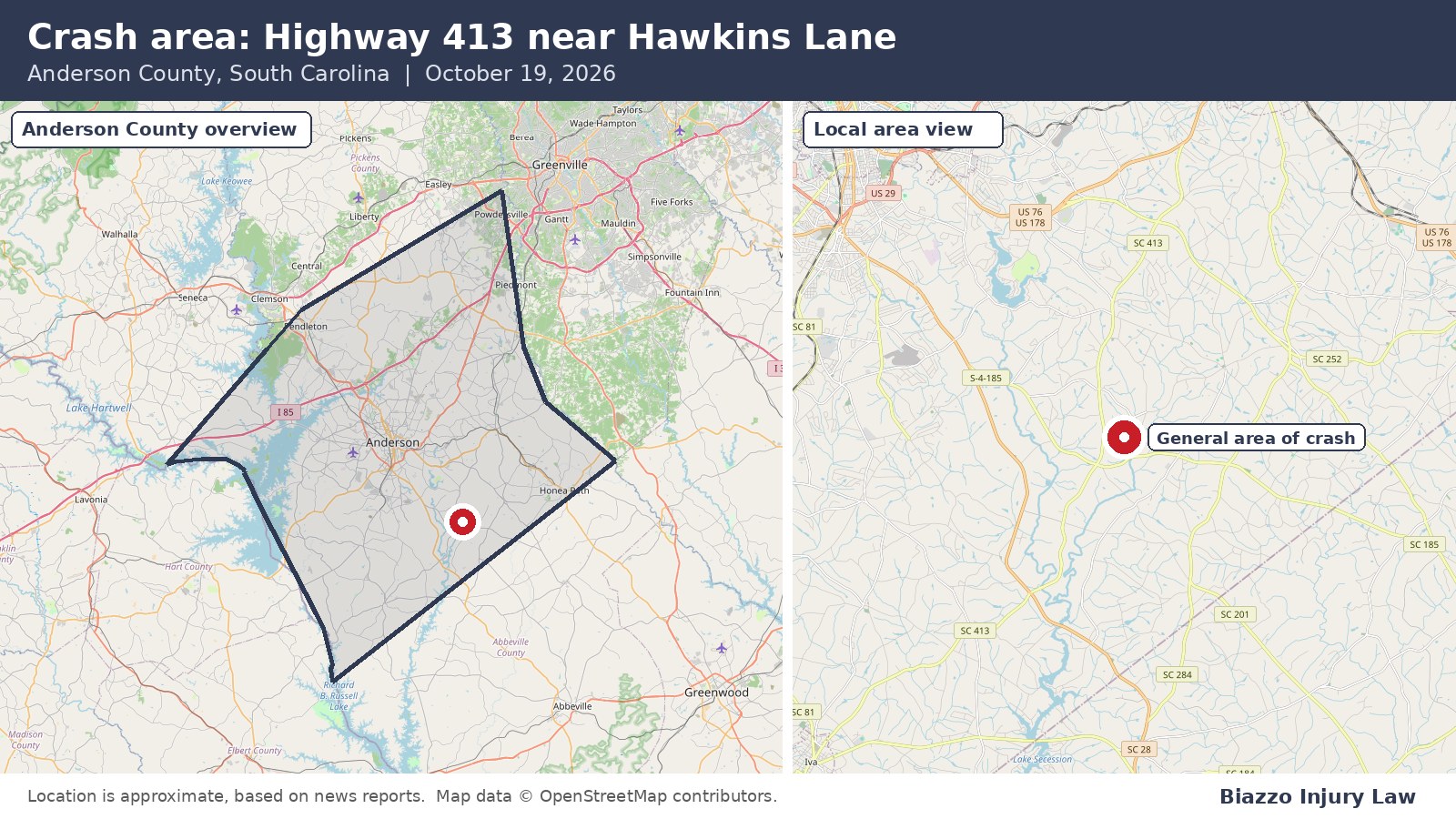
Early on Monday, October 19, 2026, a trash truck and a pickup truck collided on Highway 413 near Hawkins Lane in Anderson County, South Carolina, according to reporting from Fox Carolina. The crash happened around 6:23 a.m. The Anderson County Coroner's Office said one person died, and Fox Carolina reported the person killed was a sanitation worker. A second person was airlifted to a hospital, and Hoodline reported that as of Monday their condition had not been released. Neither outlet had named the people involved or said what caused the collision.
Approximate crash location based on news reports. Map data © OpenStreetMap contributors.
The crash comes in a year when Anderson County roads have been especially dangerous. Hoodline, citing South Carolina Department of Public Safety figures, reported 37 traffic deaths in the county from January 1 through October 11, 2026, compared with 29 over the same dates in 2025. Highway 413 has seen other fatal crashes this year as well. Behind every statistic is a family dealing with a sudden loss, and for many of those families the practical questions start almost immediately: who is responsible, and who pays for what happens next?
While investigators work to determine what happened, there is a separate civil legal system in South Carolina that exists to answer those questions. Here is how it generally works when a commercial vehicle is involved.
When a Commercial Truck Is Involved, the Company May Be Responsible
Trash trucks, delivery vans, dump trucks and other work vehicles are driven by employees, and South Carolina law can hold an employer responsible for a driver's negligence while the driver is on the job. This principle is called respondeat superior. An employer can also face a separate claim for negligent hiring, training, supervision or maintenance if, for example, it put an unqualified driver on the road or let a vehicle's brakes fall into disrepair.
Commercial cases usually turn on evidence that disappears quickly. Many heavy trucks carry event data recorders, GPS and route logs, and some have cameras. Driver schedules, maintenance records and company policies can also matter. Families and injured people are often well served by asking an attorney to send a preservation letter early, before records are overwritten or discarded.
Workers' Compensation and Third-Party Claims Can Both Apply
When someone is hurt or killed while working, workers' compensation typically provides medical care and partial wage benefits regardless of fault, and it generally limits claims against the employer itself. But if a driver or company outside the employment relationship caused the crash, South Carolina law generally allows a separate third-party personal injury or wrongful death claim against that party. The workers' compensation carrier may have a right to be repaid from any recovery, so the two tracks need to be coordinated carefully. If a government-owned vehicle is involved, the South Carolina Tort Claims Act adds notice requirements and limits on damages that don't apply to private defendants.
Wrongful Death Claims in South Carolina
When a person dies because of someone else's negligence, South Carolina's wrongful death statute allows the family to seek compensation. The claim is brought by the personal representative of the estate for the benefit of surviving family members, such as a spouse, children or parents. Recoverable damages can include funeral and medical expenses, lost income and financial support, and the loss of companionship. A separate survival action may cover what the person experienced before death. In general, South Carolina gives a three-year window to file most personal injury and wrongful death claims, but exceptions exist, which is one more reason not to wait.
Shared Fault: South Carolina's 51 Percent Rule
Insurers often look for any way to argue that the injured person was partly to blame. South Carolina follows modified comparative negligence: a person's recovery is reduced by their percentage of fault, and a person found more than 50 percent at fault recovers nothing. Because even a small shift in fault can change the outcome, how the facts are gathered and presented matters from day one. Surviving passengers or other drivers hurt in a crash like this may also have uninsured and underinsured motorist coverage through their own policy.
Talk to Someone Who Can Help
If you or someone you love was hurt in a crash involving a work truck or commercial vehicle in Anderson County or anywhere in the Upstate, you don't have to sort through insurers, employers and workers' compensation on your own. At Biazzo Injury Law, we offer a free consultation, and you pay no fee unless we win your case. Reach out to talk through your options and what to do next.
The facts referenced in this article reflect publicly reported information from Fox Carolina and Hoodline as of October 19, 2026. This post is intended for general educational purposes and does not constitute legal advice. Every case is different; contact an attorney to discuss your specific circumstances.


